July 2007

Music Reviews: July 2007

12:34 am

A FINE FRENZY
One Cell in the Sea
(Virgin)
The young lady behind A Fine Frenzy, Alison Sudol, leads this album through fantasy and whim anchored by her very voice. A voice like one of the greats, this gal has, and right out of the musical gate she’s put in the ranks of It females like Regina Spektor. More likeable than those whom similar comments could be bestowed upon (Sierra Swan and maybe the Pierces come to mind), Sudol is all talent and no fuss. Watch out.

ARTHUR & YU
In Camera
(Hardly Art)
As far as I can tell, Arthur & Yu and the horse they rode in on, Hardly Art records, came outta nowhere. And in fact, the label just began in March (as for the band, I have surely never heard of them…). Begun by SubPop founder Jonathan Poneman, Hardly Art exists AS Arthur & Yu right now, but will surely grow in the future months/years. What a novel debut it makes with this album from the Seattle duo. Over hazy, vintage sounds are the voices of Grant Olsen and Sonya Westcott, melding together in a (more) ’60s-inspired version of something like the Raveonettes. Think the Velvet Underground, sonically, but more easily digested.

Dungen
Tio Bitar
(Kemado)
Has the ghost of Deep Purple-era “Hush” risen from the grave? Can Metal and psych-folk coexist harmoniously? Have we entered a new era of flute-based rock? Is IKEA putting out albums? All these questions and more are answered on this meaningful bluster of mish-mashed genres and melodies. Just as Sweden has been long recognized as a conciliatory and diplomatic nation, Dungen caries this model to their songwriting and invites every single instrument and musical species along for the ride. Herb Alpert, Cheap Trick, The Move, Pink Floyd, and Nike Drake are all welcome in the land of Dungen.

FALL OUT BOY
Infinity on High
(Island)
Why in the bleeding hell this was ever sent to me, I have no idea. But here it is, the follow up to the breakout album of the most irritating band of the past year (or more, or since their very beginning). Why can’t this guy sing? Why are all of them dweebies? Why is the Ashlee Simpson boyfriend the only one even trying to look cool? If Fall Out Boy and N’Sync met in a dark alley, who would emerge victorious? (No one, everyone is a loser). Why am I crying? Why are my ears bleeding? Most irritating, I can’t even find any of the FOB songs I irritatingly find stuck in my head on this dud. ICK.

Goon Moon
Licker’s Last Leg
(Ipecac Recordings)
I have to confess I have a number of musical Achilles heels: Clutch, Sergio Mendes, Yes, the Allman Brothers, and Metal Church. More often then not when I confess to these weaknesses I am met with ridicule and scorn. Well add Goon Moon to the list. The bastard child of Marilyn Manson and Masters of Reality offshoots, Goon Moon is a unusual and self-indulgent piece of work filled with bloops, bleeps, whispers, hand-claps, and moans. Simultaneously simple and intricate Goon Moon knows how to infect my mind with a big ol’ dose of weird riffs. Now is not the time to run from your musical weaknesses, but to confront them with the Licker’s Last Leg.

SEAN LENNON
Friendly Fire
(Capitol)
Sean Lennon’s MySpace profile lists in its “About Me” section: “Fringe celebrity status from associated parental mythology… Better than average musician.” And upon listening to Lennon’s latest album, we’re mostly inclined to, at the very least, reverse those two statements in order, and at the very most, at least TRY to disregard the first of them entirely. Truthfully, it’s inevitable that the name catches your attention for the other Lennon. Truthfully, it’s inevitable that hazarding a glance at this Lennon reminds you of the other Lennon. But, truthfully, it’s inevitable that once this album takes shape, you’ll find this Lennon a talent in and of himself, independent of any “parental mythology.”

Money Mark
Brand New By Tomorrow
(Brushfire)
The man perhaps best known as the Beasties Boys keybordist extraordinaire, drops his first full-length record in years and it’s worth the wait. You could call this record contemporary rare groove, filled with mellow stylings that drift from jazz to soul to funk. As always, the keyboard work is great, but the best part are the melodies that get into your head and stay a while.

PANTS PANTS PANTS
Ok, Fine
(self-released)
While it’s certainly not most helpful to dwell on one particular song on an album, it’s hard not to when an electronic band from San Francisco does a cover of one of Pearl Jam’s most famous songs, “Jeremy.” It’s just too utterly bizarre to be ignored. What is great about the whole business is that, like the rest of the album, the cover is mostly completely enjoyable (and if you’re not paying attention, it might take you half the song to even realize what you’re listening to). Pants also has the market on cutest packaging, OK, Fine opens up and turns into one of those folded fortune teller things you made in elementary school.

PROSSER
Prosser
(ClickPop)
Multi-talented, multi-instrumentalist Eric Woodruff will be hard to ignore. In his best vocal moments, he is a woodsier Elliott Smith, acing in a way that will catch you unexpectedly given the moody soundscape that surrounds him. Woodruff is undoubtedly a Northwest diamond in the rough.

The Queens of the Stone Age
Era Vulgaris
(Interscope Records)
Over the last twenty years the pharmaceutical industry has flooded the market with every get up, get down, get left, get right, get high, get straight pill known and unknown man. The Queens of the Stone Age have pulled down an abundance of these pills, but not the kind that fix bi-polar behavior, but exacerbate it. Era Vulgaris is a radical shift from the dark and loamy affair of their last album. This has got all the vim, vigor, skip, and hop of a handful of erectile dysfunction pills. Sure it has some dark moments, but they are quickly trampled underfoot by a perky Panzer Division of mechanized riffs. The Queens of the Stone Age are dead-Long live Era Vulgaris.

SMILE LINE SPARK
Demos
(self-released)
Reunited and it feels so goooood. Back from a brief hiatus-in which front man Patrick McHenry dabbled in some other musical stylings, a little solo work, and other members dropped in and out-Smile Line Spark is now back in the local scene, once again leaving their mark. Spokane has (always had) its fair share of those tugging-at-heartstrings types, but Spark, with refreshing honesty, manages to be (and really excel at being) altogether more sincere and likeable than the imitators. Watch for new material soon.

WE WROTE THE BOOK ON CONNECTORS
Almost the Mayors of Laser
(self-released)
I genuinely have no f-ing clue how a clan of four supa-nerds singing about eating cake, admiring Ichiro baseball cards and M-U-S-H-R-O-O-M C-H-A-I-Rs have made it in a scene so stingy it lets most of its most amazing bands go unrecognized. But they have. Seattle has birthed one whacked out band here (just ask Seaweed Jack, they’ve now shared the stage with the Wroters not once, but twice) and darnnit if the success ain’t a little enviable. Fortunately, and most surprising, is that We Wrote doesn’t totally suck. It’s fun music, easy to listen to, and even worthy of a little dancing.

Magazine Article, Music Reviews |

Book Reviews: July 2007

12:33 am

Cycling’s Greatest Misadventures
Erich Schweikher, Editor
Casagrande Press, 2007, 254 pages.

Cycling’s Greatest Misadventures, edited by Portland’s Erich Schweikher, is a collection of tales chronicling the adventures-the good, the bad, and the mundane-of bicyclists from around the globe. Schweikher’s collection includes the tales of tourists, commuters, racers and others looking to understand themselves through their cycling.

As with most adventure tales, these are of wildly divergent interest and readability. Some of the longer tales would do well to be shortened, particularly the tale of the cross-country tour leader who loses a rider to a fatal collision, through no fault of her own, on two consecutive trips. While a touching tale, it plods like a long climb.

The flipside is some under-developed tales, such as that of a rat hitching a ride on the handlebars of a Washington, D.C. commuter. The rat jumps from a wall to her handlebars and falls between the hub and spokes of the front wheel, its tail lashing her shin with each revolution. The author hyperventilates, abandons her dinner plans and returns home to recover, all in a few hundred words. Too much is left to the reader with this one.

Among the more engaging tales is that of the Buffalo Soldier Bicycle Corps of Fort Missoula, Montana. Led by an innovative young Lieutenant Moss, the “Iron Riders” traded their horses for bicycles, the alternative transportation of their future, or so Moss thought. The appeal was not having to groom or feed horses. Even with mud clogged tires and gears, the men made twice the time they could marching, and often out-paced soldiers on horseback.

But for every inspiring tale, there is something equally mundane: a tourist struggling with potassium levels, a collector of junk in Boise (one of several graduate student tales), and idiots scattering tacks on a race course hoping to meet racer babes. Cyclists tend to take in stride the good, bad and mundane on each ride. Do so with these (mis)adventures, and you’ll have some reasonably pleasurable beach reading or the means to while away a rainy afternoon.

Bradley Bleck


The Eiger Obsession: Facing the Mountain that Killed My Father
John Harlin, Simon & Schuster
2007, 304 pages.

Given that more than 48 climbers have died on the north face of the Eiger, an uneventful climb is next to impossible. Pair that with the mountaineering legacy forever tied to John Harlin III, and The Eiger Obsession easily surpasses most mountaineering books.

Even now, John Harlin II stands out in the sport of alpinism and was arguably the greatest mountaineer of his day. He put together a solid climbing resume complete with famed first ascents, notable rescues; as well as initiating a climbing school. Tragically, he will likely always be known as the man that died in 1966 on the north face of the Eiger when his over-used rope snapped and he fell 4,000 feet.

It comes as no surprise that nearly 40 years later, the 13,025-foot Eiger preoccupied his son, John Harlin III, also an accomplished climber and the previous editor of The American Alpine Journal. Though he often vowed he would not follow his father’s path, particularly on that specific mountain, the notoriety was unavoidable.

Perhaps that’s the key to this book’s success. After all, doesn’t the public like to know that McQueen or Lennon’s son turned out okay? Did they or did they not follow their father’s path?

“The Eiger held a part of my soul captive for forty years, and with this trip I was able to set myself free,” says John Harlin III of his achievement.

Thankfully, Harlin III avoids most of the climbing-as-life-metaphor clichés that mar so many mountaineering books. The rope need not always be an allegory. The greatest climbs are certainly not found solely on Everest.
I particularly applaud him for giving a fair tribute to a legendary climber, while still citing his father’s faults at home or in his marriage. This keen background supplements the events leading up to the climb, and then delivers the reader inside a very personal triumph and a wonderful celebration of life.

Jon Jonckers


Brotherhood of the Rope: The Biography of Charles Houston
Bernadette McDonald, Mountaineers Books
2007, 238 pages.

If Bernadette McDonald’s award winning biography of Elizabeth Hawley, I’ll Call You in Katmandu was a home run, her latest work, Brotherhood of the Rope: The Biography of Charles Houston, is a grand slam. At 93 Charlie Houston who fashions himself as “just a country doctor” remains an icon of mountaineering history. Carefully blending lively narrative, references to the ideas and opinions of Charlie’s colleagues and friends and his own words, McDonald weaves an enlightening tale. Probing into Houston’s past McDonald finds a moderately talented youth with a deep interest in nature. His outdoor interests, expanded during family summers at Honnedaga Lake, an upstate New York wilderness enclave, ultimately lead him to his duel career in medicine and mountaineering.

From his emergence on the climbing scene as one of the “Harvard Five,” to Charlie’s final climb – the legendary 1953 American K2 expedition, McDonald describes not only Houston’s climbing experiences but also the motivation behind them. Allowing us to discover the mountaineering part of his life through Charlie’s own works on the 1938 K2 trip, Five Miles High, and his account of the 1953 adventure, K2: The Savage Mountain, McDonald focuses on Houston’s personal and professional lives. The book explores his pioneering medical research in high altitude physiology both as a Navy doctor and later in the Mt. Logan High Altitude Physiology Study. Houston’s work Going Higher, in its fifth edition is required reading in the field. McDonald explores his medical practices in New England and Aspen, Colorado and his service with the Peace Corps in India in the 1960s.

The accompanying 43-minute documentary DVD Brotherhood of the Rope describing the camaraderie of the 1938 and 1953 K2 expeditions alone justifies the book. The taped conversation among the survivors of the 1953 expedition in base camp provides an insightful high point for the work. Paul McGowan became Houston’s eyes for work on the film; Charlie was nearly blind from macular degeneration during its production.

Stan Miller

Book Reveiws, Magazine Article |

What’s Your Gear? Longboarding

12:32 am

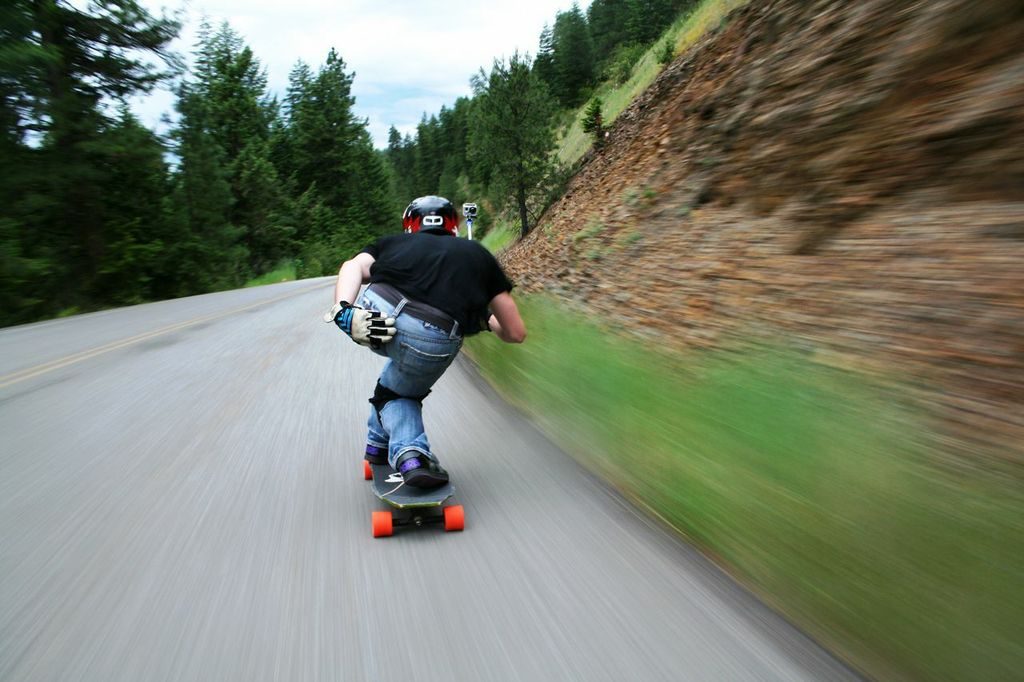
Mark Harris lives his life carving hills. A former competitive snowboarder, the current Schweitzer snowboard team coach took up longboarding during the summer to fill the competitive void and fell in love with the sport and its lifestyle.

“In this high tech world with cell phones and PDAs, where our cars talk to us and park themselves, there’s a real beauty in the simplicity of a skateboard.”
“The competitive side is very serious but also very supportive-it’s like minded people just out to have a good time.” There aren’t a lot of local longboard competitions; most of the comps are on the coast in the Seattle area or in Oregon, but Harris is working with the Spokane Parks and Recreation Department, the YMCA and the local skate shops to organize more local events and competitions.

Most recently he traveled to the Oregon State Games in Salem, a three-day event in which he competed in the Park Slalom, a timed event within a typical skate park, a Giant Slalom race, and a Tight Slalom, where the boarders make three to four turns per second in a downhill course.

Boards: Harris has more than a few boards, but the highlights of his collection include the Long Board Larry Tarpon board his wife bought him for Christmas, the Gravity 36 board he uses for the Park Slalom events, and the Roe Racing board for GS.

“Every board, every material has a little different personality,” Harris says. The Tarpon is made of baltic birch, “which gives it strength and resistance, a layer of carbon-fiber for dampening, and bamboo for added strength and flex while still being lightweight.”

The Gravity 36 is made of hard rock maple, and the Roe board is “a carbon-fiber raceboard made by a guy in Seattle who makes some of the best raceboards in the world.

Trucks: “On my downhill board I run Randall downhills,” Harris says, and for the park slalom: “Trackers-they’re one of the oldest companies in skateboarding, they’re and industry standard and a brand I’ve trusted and used forever and ever.”

“The GS and Slalom trucks are much more specialized. You can spend huge amounts of money on trucks, but there’s also a lot of great guys out there on standard-issue Trackers.” For his Slalom board, Harris uses Splitfire trucks on the front and Airflow trucks in the rear.

Wheels: “For all racing other than park, my wheels of choice are Abec 11-the company is owned by a long-time racer, so he’s got the right combination of size, shape and construction of the wheels, and the right urethane mix.”
For the park slalom, Harris prefers wheels by Bulldog skates.

Shoes: “I wouldn’t say there’s one brand that’s better than the rest,” Harris says, but shoes are important in a sport where your equipment is brakeless. Currently Harris is racing in a pair of DVS shoes with a hard rubber sole.

Helmet: Harris uses the Pro-tech Ace Helmet.

Body Armor: Harris has yet to start racing in the downhill competitions where velocity requires leather suits. However, he says, “asphalt hurts, and if you’re fully padded up you can push yourself that much harder knowing you can take it in the pads rather than leaving your skin on the streets.” He uses knee and elbow pads by TSG and wrist guards by Pro-design.

And you thought longboarding was just a great way to tackle the fossil fuel shortages.

Magazine Article, What's Your Gear? |

Everyday Cyclist: Haul Kids on Your Bike

12:31 am

Since our 4-1/2-year-old daughter was about a year old, she’s spent most of her transport time on a bicycle. Our family shops, runs errands, goes to school, and generally gets around by bike, and in most cases, Maddie is with us.

Over the last few years, in our quest for the perfect “kid-hauler”, my wife and I have tried out a lot of options. In this column, I’ll give you some of our impressions.
Before diving in, though, it’s worth noting that we have only one child. This makes a huge difference in our options. In the U.S., if you want to haul two kids with one bike, you’re pretty much stuck with a trailer. Not to say there aren’t other options, but they aren’t readily available and they are expensive. For more information, see the links at the end of this article.

The first option we tried, and the only solution that I know of for a one-year-old, is a trailer. Different folks have different opinions about when it’s safe to put a baby in a trailer. I used to commute the same direction as a guy who hauled his six-month-old son in a car seat that was strapped into the trailer.
Maddie was about eight months old and holding her head up when I first put her in the trailer. One of the first things I noticed was how jarring the ride was. On a bicycle, you are suspended between two wheels on a frame. In a trailer, children sit directly over the axle, and every bump is transmitted directly up their spine. I never liked that, and I don’t like the feeling of pulling a trailer and how it affects handling.

Aside from these issues, there are many benefits to trailers:

  • You can haul more than one kid, assuming you get the two-child trailer.
  • There’s room in a trailer for groceries and other luggage.
  • In the winter, you can pile on the blankets and the child can nap, read, and play with small items in a dry and warm spot.

Just about any bike can take a trailer, and they are easy to hook up and remove, so you’re not stuck with a kid attachment on your bike when you’re not riding with your child.
For most people, a trailer probably is the most practical solution.

As Maddie grew older (and taller), she was less interested in riding in the trailer. When she was about 2 1/2, we found a front-mounted seat for toddlers. The seat is a little plastic saddle that bolts to the top tube of the bike. Little foot pegs are included in the package. The pegs bolt to the down tube.

The idea is that the child sits on the seat in front of you, puts her feet on the pegs, and holds onto the handle bars. This solution is ideal for a toddler.

In countries where bikes are used more for transportation, you see kids riding up front almost exclusively. It makes sense. Unlike a rear-rack-mounted child seat, the child is right in your center of gravity, making the bike much easier to control and the load easier to carry. With the child in front, you can chat easily with her; she can watch and learn and be engaged with the goings-on of traffic. She can ring the bell, turn on the light, make hand signals. Some of my best conversations with Maddie have been on the front-mounted seat as we ride around and do our otherwise mundane errands.

There are different versions of the front-mount seat, but only a few are available in the U.S. In my opinion, the best version is called “Companion Carrier,” from a small company in Eugene, Oregon. They have no web site, but you can Google the name and find contact information for them.

The rear-rack mounted child seat is likely the cheapest and easiest solution for folks that want a simple solution for occasional rides with their kid. I don’t like them for daily use because they take away the rear rack, which I use for groceries or a basket. They also put a lot of weight up high and behind you, which I find really affects the handling on most of the bikes I ride. But these seats are easy to come by, and kids typically like them.

As the child gets older, and heavier, there are two options for getting some help from them as you ride: tandems or the “trail-a-bike.” We’ve not tried a trail-a-bike, so I can’t comment on those. We have, however, recently purchased a tandem that fits Maddie, and it has been wonderful.

At least two tandem companies make a bike that small kids (36″ or taller) can ride: Bike Friday and Co-Motion. Interestingly, both companies are in Eugene. We found a used Bike Friday “Family Tandem” on Craigslist in Seattle and have been riding it daily since we got it. You really can feel the boost when your stoker puts out some energy. The tandem has a rack, so we can load it up for grocery shopping, playing, or even quick overnight camping trips.

So far the tandem has been the best solution and I look forward to many years of riding with Maddie on it.

Some interesting non-standard ways to haul kids:
Xtracycle: http://www.xtracycle.com
Dutch bakfietsen: http://clevercycles.com/

John Speare grew up and lives in Spokane. He rides his bike everywhere. Check out his blog at http://cyclingspokane.blogspot.com.

Everyday Cyclist, Magazine Article |

Colville’s Auto Vue Drive-In

12:22 am

The North Cedar, the last drive-in theater in Spokane closed in 1993. At one point, Spokane was home to seven drive-ins-more than any other city in Washington State (Seattle can boast only having had two). Now, movie watchers itching to recreate the drive-in movie experience of their youth must travel north of Spokane to the Auto Vue Drive-In in Colville, WA-one of the last remaining drive-ins in the state.

Auto Vue first opened in 1953 and is still run by the same family. Steve Wisner, owner of the Auto Vue has been fixing movie speakers since he can remember. While many drive-ins around the country were shutting their doors after the onslaught of the home video, Wisner decided to move away from the standard drive-in format of showing only second runs.

“We started to do first runs and opened it only on the weekend. When I took over in ’94, I started opening it six days a week and business went up about 35 percent. It was profitable so we kept it that way,” says Wisner.

The flat dry field at the Auto Vue can hold up to 220 cars, and in true drive-in style, trucks, are backed in, and outfitted with lawn furniture in their truckbeds during showings. While the surrounding mountains of the Colville National Forest are stunning, much past dusk, you will not be able to notice. Missing from the drive-in are the post-mounted speakers seen in earlier drive-in eras. The Auto Vue now feeds its sound through your car’s AM or FM radio. The speakers were removed in 1982.

Admission is $6 per adult, $2 for children, 11 and under, and on Wednesdays, $10 can get your entire carload in. While there is no play equipment to keep younger children occupied, groups of children roam freely among the field of cars, going to and from the “Spanish-Deco” style concession building and restrooms. Traditional movie fare with the addition of pizza can be purchased on-site.

The Auto Vue’s season runs from April to the first of September and is open Friday through Wednesday. Movies change weekly, so call ahead to find out what is playing. Double features are the norm with the first movie starting at dusk-in mid-June this can mean close to 9 PM, so don’t expect to make it out any earlier than 1 AM if you plan to stay for both movies.

If you decide to stay until it really is too late to drive back to Spokane, Colville and the neighboring Kettle Falls area offer a variety of affordable accommodations. If you are looking for a quick retreat, your best bet is to stay in Colville at either the Colville Comfort Inn or Benny’s Colville Inn on Main Street.

If you decide to stay a little longer, there are numerous B&Bs and cabins available for rent that can allow for outdoor exploration of the Colville and Columbia River Valleys. Rich Landers, in his 100 Hikes in the Inland Northwest, mentions four fantastic hikes just outside of Kettle Falls and many more near Ione. The city of Colville, itself, boasts numerous excursions as well, from the friendly regulars at The Logger Tavern to paintings by Leno Prestini at the Keller Heritage Center Museum. Colville also has numerous festivals planned this summer, so visit their website if you would like to combine a nostalgic night at the drive-in with mid-day fun.

The Auto Vue Drive-In is located at 444 Auto View Road, Colville, WA, just past downtown Colville, follow U.S. Hwy 395 and take a left on Auto View Road. Call (509) 684-2863 for movie information.
For lodging in Colville:
Benny’s Colville Inn: (800) 680-2517 or http://www.colvilleinn.com.
Colville Comfort Inn: (800) 228-5150 or http://choicehotels.com/hotel/wa717

For lodging just outside of Colville:
Beaver Lodge & Resort: (509) 684-5657Blue Moose Cabin Rentals: (509) 738-6950 or http://www.bluemoosecabins.com.
The Whitetail Inn: (509) 684-8856.

WHEN YOU GO:

Colville is located at the junction of U.S. Highway 395 (north-south), which runs completely from Mexico to Canada through the center of Colville, forming the town’s main street, and State Highway 20 (east-west), which runs from the Idaho-Washington border to the Pacific coast and Washington’s San Juan Islands.
For a scenic drive along the Pend Oreille River valley head north from Spokane along Hwy 2. Just before Newport, WA look for signs to Ione and Metaline Falls take a left onto WA-211. Go about 15 miles. Turn left onto WA-20 and go 36 miles to Colville.

For a quick side trip check out the Manresa Grotto, a natural cave located on the Kalispel Indian Reservation just outside of Usk, WA.
Manresa Grotto is a cave that is located within the Tiger Formation-one of the most unusual geologic structures in Washington. The Manresa Grotto cave lies above the Newport fault. In the mid-1800s, Father DeSmet, a Catholic Priest, named the cave “The New Manresa” and had an altar built of stone that is still there today, along with flat rocks that served as pews.
To reach the Manresa Grotto, drive north on Highway 2, just after the WA-20 turn-off to Ione, you will reach Usk, WA, turn right onto Kings Lake Road and cross the Pend Oreille River onto the Kalispel Indian Reservation. Take a left onto Le Clerc Creek Road and drive for about 15 minutes and you will see Manresa Grotto on the right side of the road.

Magazine Article |

Out There Monthly Wins Awards

12:21 am

In June, Out There Monthly won three first place Excellence in Journalism Awards from the Society of Professional Journalists, or SPJ. The 2007 awards were given for material published in 2006. The publication received two awards in the non-daily newspaper category from the Inland Northwest Chapter of SPJ, which includes news outlets from Eastern Washington, Northern Idaho and Western Montana. Contributing Writer Jess Walter won First Place, General Columns, for his piece about Kendall Yards entitled “Urban Outdoors-July,” and Art Director Kaitlin Snyder won First Place, Page Layout for the April piece about freestyle mountain bikers entitled “Freeride Freaks.”

In addition to the Inland Northwest SPJ awards, Out There Monthly also received a Region 10 SPJ award, which covers publications in Oregon, Washington, Idaho, Montana, and Alaska. Art Director Kaitlin Snyder won First Place, Page design for her 2006 OTM covers, beating out Second Place winner Seattle Weekly, and Third Place winner The Pacific Northwest Inlander in the alternative newsweekly category.

“It’s really exciting to see the SPJ judges select Out There Monthly over other publications that are much larger and have been around a lot longer than we have,” said OTM Publisher Jon Snyder. ” Our goal is to encourage readers to have a fun, healthy, outdoor lifestyle, and think about how they can help preserve the environment for future generations.”
According SPJ Region 10 Director Nathan Isaacs, The Pacific Northwest Excellence in Journalism Contest is among the oldest and largest regional contests in the country. This year almost 3,000 entries were submitted in the regional contest, which includes categories in newspapers, television, online, alternative newspapers and radio.

“Judges were impressed by the high caliber of journalism performed daily throughout the Pacific Northwest,” said Isaacs, writing on his SPJ Region 10 Blog.

“Congratulations to Jess and Kaitlin for being recognized for their efforts,” said Publisher Jon Snyder. “These awards are great for them and they are also a great validation of all the folks who work so hard every issue to make Out There Monthly a reality.”

Magazine Article |

Editorial – Cops: Centennial Trail

12:10 am

“Back off! We’ve got a pit bull!” says a voice from the bushes. I don’t think the homeless couple realize it’s an armed park ranger approaching.

I never had an interest in doing a law enforcement ride along. But when Ranger Jody Maberry invited me to come along on his bike patrol of the Centennial Trail, I was there. For a couple hours on a nice Friday night in June we rode up and down what Ranger Maberry says is the most active stretch of trail-between Avista and G.U. After three years, it’s his last day on the trail before transferring to the west side. I just got to witness his last illegal camping citation.

And his last arrest. We take a water break to chat, and an inebriated gentleman with a moustache and baseball hat approaches us with a malt liquor tall-boy. Perhaps the gun on Ranger Maberry’s hip is not big enough, because this guy did not realize Mayberry was a park cop. Ranger Maberry, of course, has to cite him for alcohol possession, a big no-no on the trail. (Alcohol is the second most issued citation on the trail, according to Maberry, the first being dog off-leash.)

I watch the man being put on the ground, hand cuffed, and taken to a patrol car with what seems to me the right mix of stern direction and sincere regard for the condition of the drunken individual, who has been taken into custody not because of his poor choice in drinking locations, but because they ran his ID and he has an outstanding warrant.

Maberry, despite being exposed to more nastiness on the trail than most users will ever see, is genuinely in love with the Centennial Trail and it’s recreational possibilities.
He is excited about the addition of the Nine Mile Resort to Riverside State Park and how a future two-mile extension will link the resort to the current trail. He and his co-workers have pushed the creation of a new hike-in, bike-in primitive camp area on the south bank of the Spokane River overlooking the Bowl and Pitcher. And he gushes about current State Parks head Rex Dur’s vision of completing a statewide east-west trail link by 2015.

I find out that almost everyone says “hi’ to a Park Ranger on the Centennial Trail. The big difference from other places he’s patrolled? “You get a lot more ‘Thank yous,’” says Ranger Mayberry.

Editorial, Magazine Article |